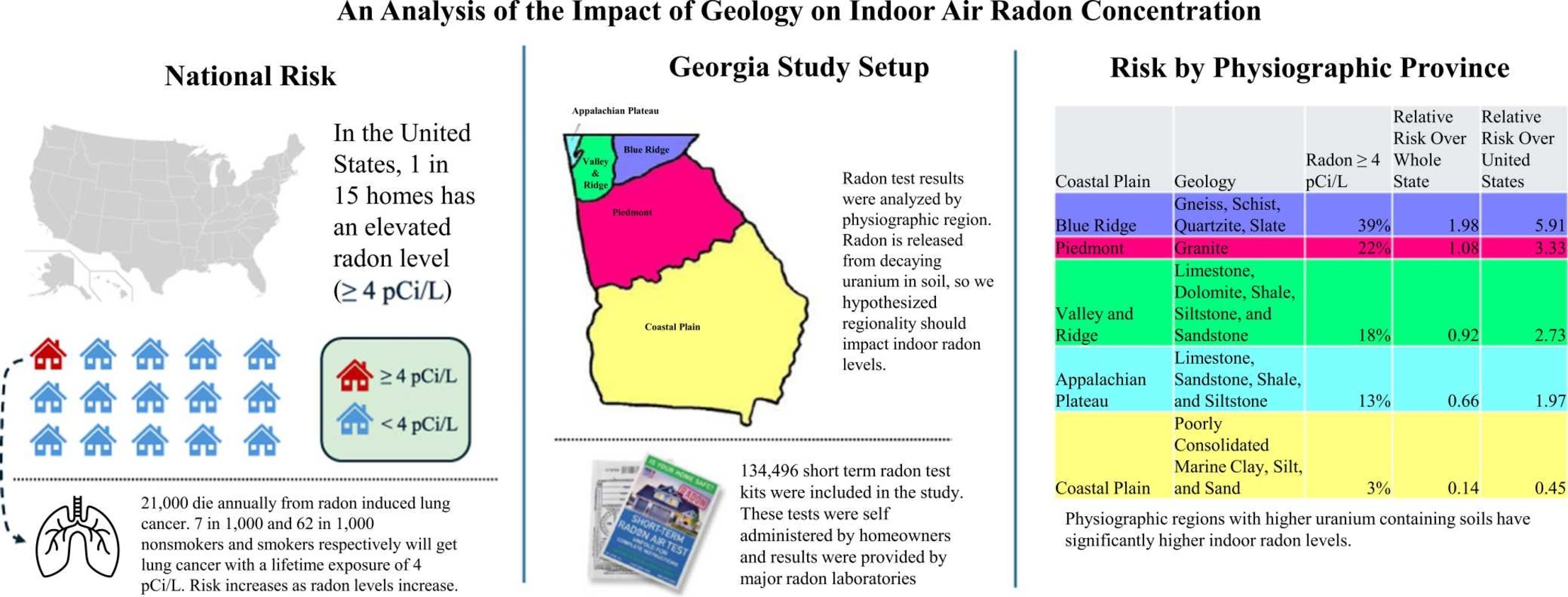
Research
Indoor Air Radon Testing Rate and Its Relationships with Various Socioeconomic and Public Health Factors in Georgia, USA
https://doi.org/10.3390/ijerph23040450
Editor's Choice Award, Journal Cover
- Publication date - Apr 1, 2026
- Journal - International Journal of Environmental Research and Public Health
- Volume - 23
- Issue - 4
- Pages - 450
- Publisher - MDPI
Radon (222Rn86), the second leading cause of lung cancer, is common in indoor air. However, radon testing is generally low throughout the US. In this study, we utilized 134,496 short-term indoor air radon test results from Georgia, USA. We investigated the association of the radon testing rate with a total of 104 different independent variables belonging to seven categories: (1) Demographic and Neighborhood Characteristics; (2) Housing Characteristics; (3) Literacy and Numeracy; (4) Employment and Economy; (5) Selected Social Factors; (6) Access to Computer/Internet; and (7) Status of Healthcare, Health, Well-being, and Lifestyle. We used Bivariate Correlation, Multivariate Ordinary Least Squares (OLS) Regression, and Factor Analysis, followed by factor score-based OLS regression. Significant negative associations of the testing rates were observed with population diversity, residential segregation, urban population density, younger population, housing age, household size, low literacy, unemployment, childcare cost burden, poverty, obesity, and the frequency of mentally and physically unhealthy days. In contrast, testing rates were positively associated with older population, home value, owner-occupied homes, higher literacy, higher institutional education, income, prevalence of social association, and life expectancy. The findings provide valuable insights for identifying the communities where socio-culturally relevant outreach activities would increase testing rates and minimize the public health consequences of environmental radon.
An analysis of the impact of geology on indoor air radon concentration
https://doi.org/10.1016/j.indenv.2025.100143
- Publication date - Dec 6, 2025
- Journal - Indoor Environments. Volume 2, Issue 4. Page 100143.
- Volume - 2
- Issue - 4
- Pages - 100143
- Publisher- Elsevier
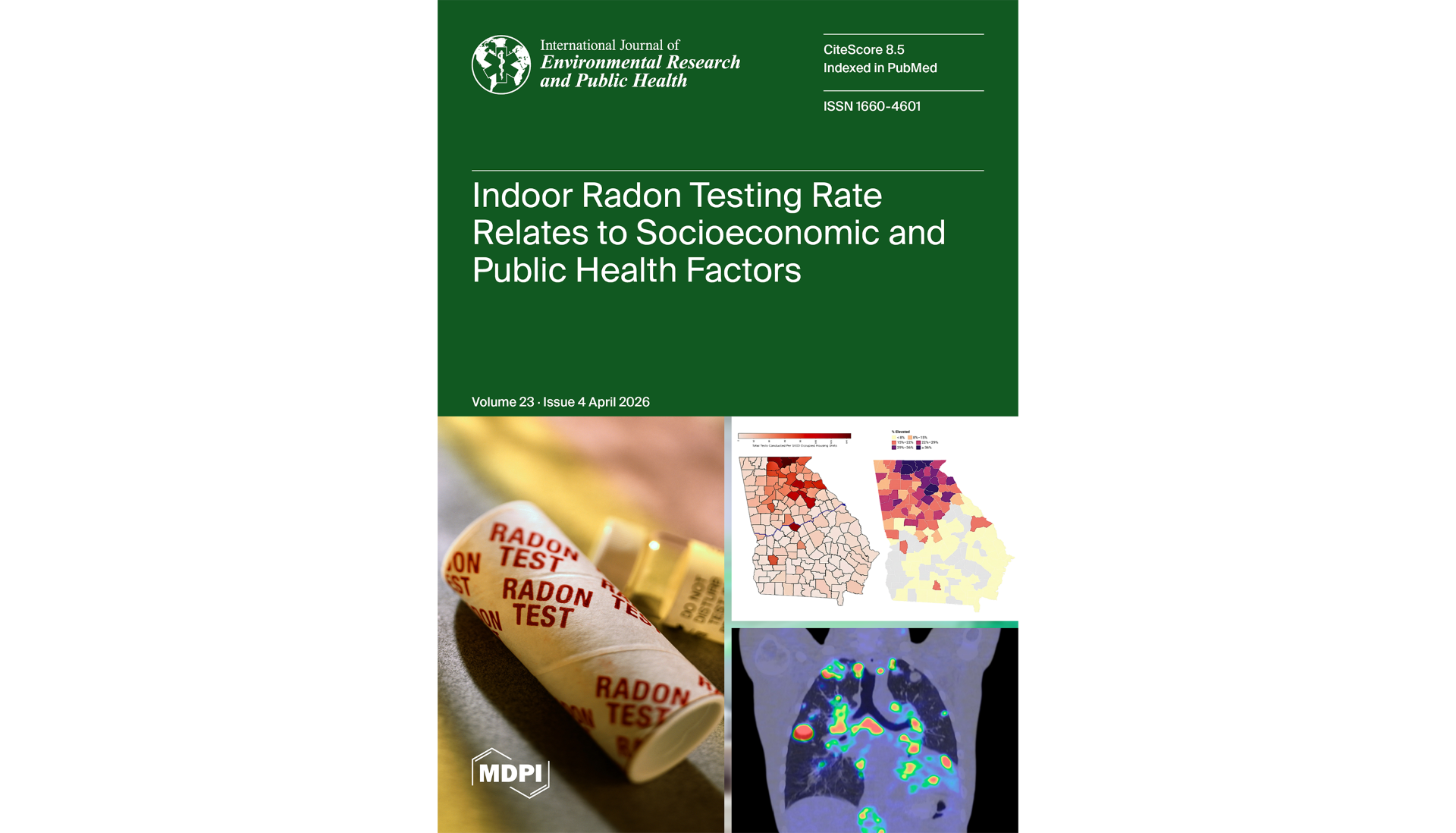
Radon (222Rn86), a radioactive gas formed by the decay of uranium and radium in rocks and minerals, can seep into houses, accumulating in the indoor air. Breathing radon-rich indoor air is the leading cause of lung cancer, after smoking, resulting in around 21,000 deaths in the US each year. The US Surgeon General advises taking action at 4 pCi/L or higher. Approximately 1 in 15 homes could have an indoor air radon concentration at or above 4 pCi/L. In this study, 134,496 indoor air radon test results from the state of Georgia, USA were analyzed. The tests were conducted between 1990 and 2022. The test results were analyzed in relation to the five well-recognized physiographic provinces in the state with contrasting underground geological features. Significantly different mean/median/mode and spread of radon concentration, frequency of high radon, and potential lung cancer risk were evident for different physiographic provinces. The highest indoor air radon levels and the highest lung cancer risk in Georgia were associated with the underground metamorphic rocks Gneiss-Schist-Quartzite, followed by Granite, Limestone-Dolomite-Shale, and Limestone-Sandstone-Shale. The lowest radon and lung cancer risks were associated with the unconsolidated marine sediments, but the risk was still significant. These findings help to substantiate the need for supporting policies and education related to increasing radon testing, mitigation, and regulations, especially in states with similar geological features. Population density, diversity, rurality, and health-literacy in various physiographic provinces should be considered together with these findings to properly realize the risk of radon from a public health standpoint.